User Guide
Introduction
Welcome to the PathogPDx Prediction Platform! This web-based tool is designed for researchers and scientists to predict paediatric RTIs pathogens based on clinical data. Our platform utilizes advanced machine learning algorithms to provide accurate predictions for various RTIs pathogens.
PathogPDx supports prediction for multiple pathogen types including bacteria, viruses, and fungi, totaling 22 RTIs-related pathogens. The platform accepts clinical data in standard formats and returns comprehensive prediction results within minutes.
Frequently Asked Questions:
A: First, you could find the prediction website in "PathogPDx Prediction" page of PathogPDx. Second, either input feature values manually or upload a properly formatted file (CSV, TXT, or XLSX). Just click the "Submit" button, wait a moment, you can get the prediction results of RTIs pathogens. If you upload a non-compliant file, the system will prompt you with an error notification. You may then click the 'EXAMPLE FILES' button to download our template file and modify your file format accordingly.
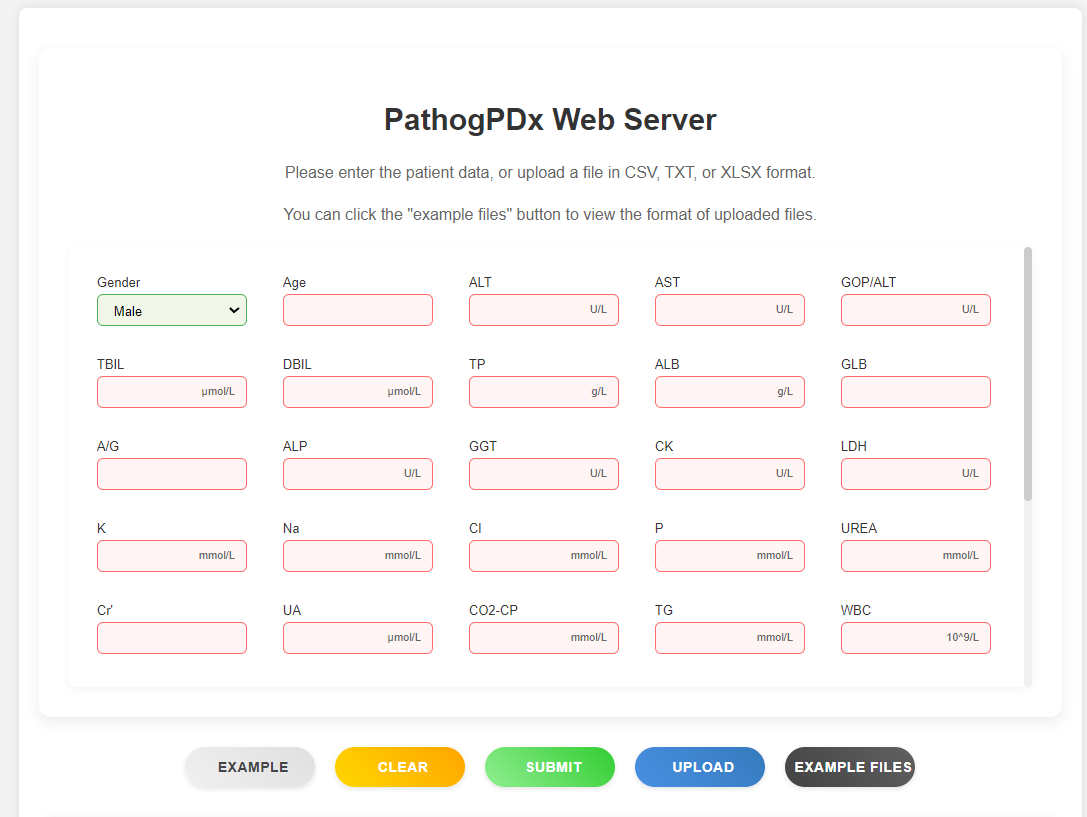
A: We provide 2 modules of prediction for users.
(1) Pathogens Web Server: After uploading your data, click 'Submit' to run the pathogen prediction immediately.
(2) Critical illness Web Server: On the top-right corner of your PathogPDx prediction results page, click the 'Severe Prediction' button to access critical risk assessment.
A: Here we use the patients as the example. After clicking "Submit", the prediction results of RTIs pathogens as follows:
The table of the PathogPDx results
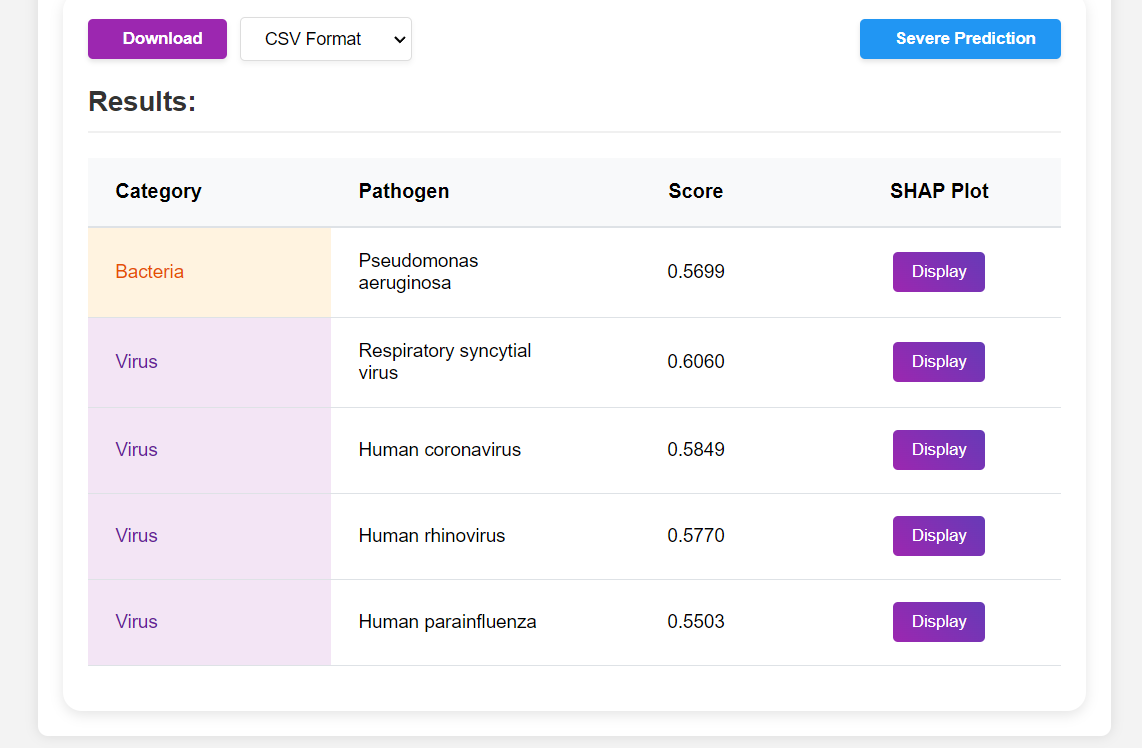
Category: Predicted pathogen type (e.g., Viral, Bacterial, Fungal)
Pathogen: Predicted pathogen subtypes (e.g., Influenza, Streptococcus pneumoniae)
Score: The value calculated by PathogPDx algorithm to evaluate the infection risk (Range: 0-1). Higher values indicate greater infection risk.
Download: Save and download results as CSV, TXT, or XLSX files.
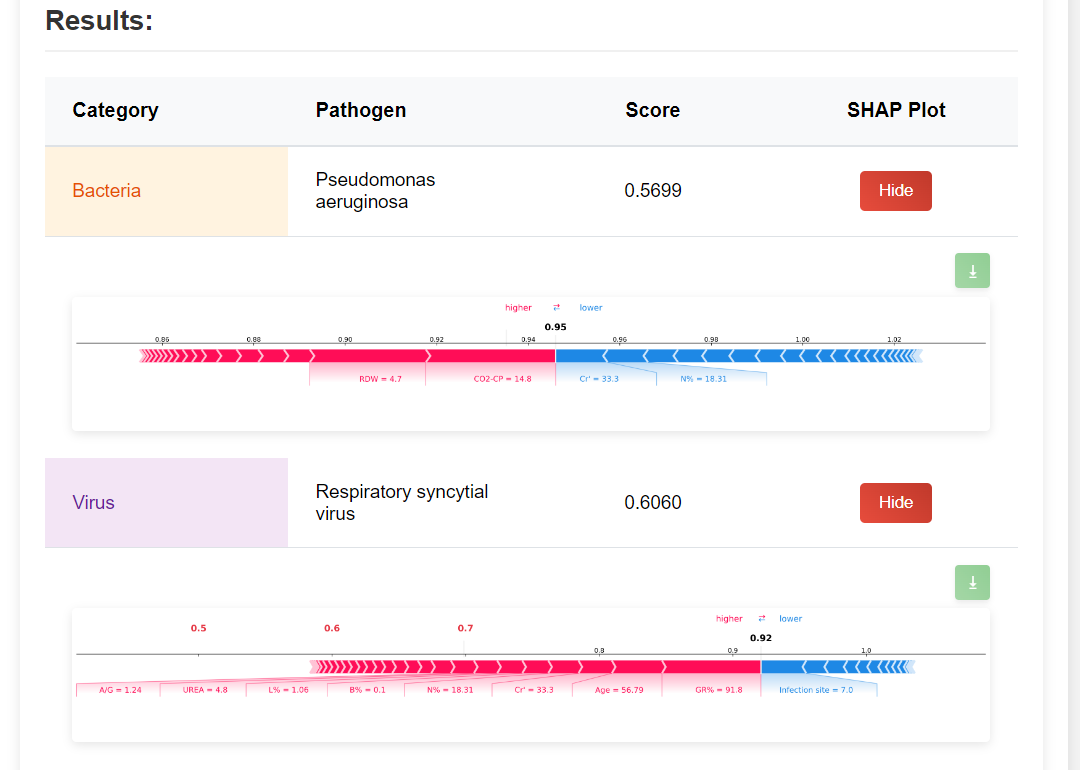
SHAP plot: Visualizes feature contributions to the prediction using SHAP (SHapley Additive exPlanations) values. After clicking "Display", the plot and evolution of risks contributed by each feature for individual child at low or high risk of developing RTIs pathogens.
Severe Prediction: On the top-right corner of your PathogPDx prediction results page, click the 'Severe Prediction' button to access critical risk assessment.